

AI is your new buyer. Here’s what’s changed in how people research, evaluate, and choose vendors, and what a solid foundation for AI optimization looks like.
The way people show up to your website has changed, and it happened faster than most teams expected.
I’ve been in marketing and sales for over 20 years, and the way buyers find us looks nothing like it did even two years ago.
It used to be simple. Someone had a problem, they Googled it, they landed on your homepage, they clicked around, and they slowly figured out who you were. That was the game.
Not anymore.
These days, before someone types your company name into anything, they’ve already spent an hour talking to ChatGPT or Perplexity. They’ve asked it to compare you to your top three competitors. They’ve asked which one fits their situation. They’ve asked what to watch out for. The conversation that used to happen on a discovery call is happening with a chatbot the night before.
By the time they hit your site, they’re not curious. They’re checking a story that already exists in their head.
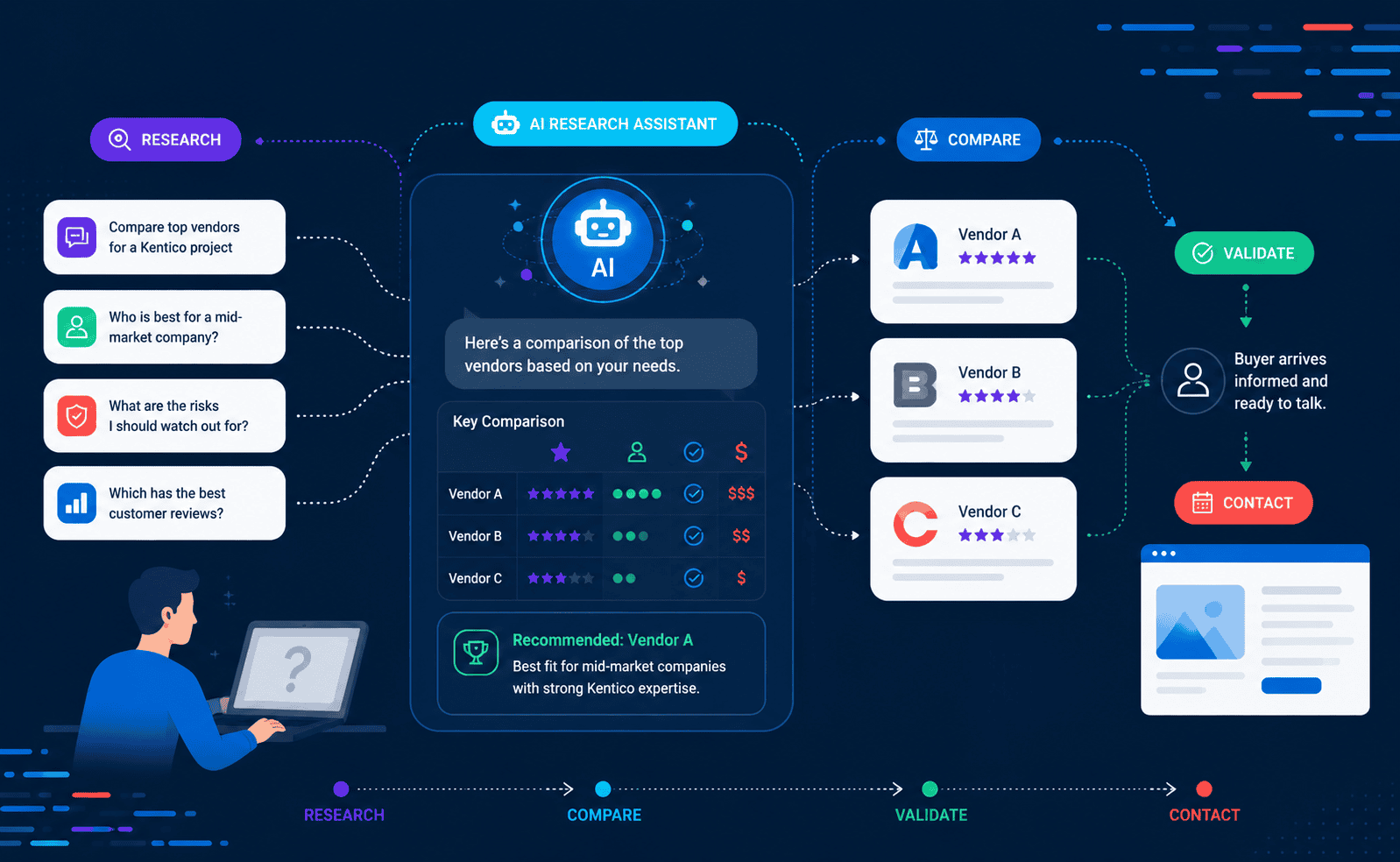
The buyer journey didn’t just speed up. It got reshuffled.
Buyers now arrive deep in the middle, sometimes at the bottom, of the funnel. They’ve done their research. They’ve narrowed the list. They’ve already formed an opinion about your pricing, your strengths, and where you’re weaker than the competition. They’re not looking for an overview page. They want to confirm what AI told them, or catch where it got things wrong.
Buying committees changed too. The person doing the research before a meeting isn’t always the buyer anymore. It might be a junior team member, an executive’s chief of staff, or a procurement lead who pulled a comparison from ChatGPT in five minutes. Multiple people are arriving with multiple AI-generated summaries. Your site has to land for all of them.
And the patience is gone. A buyer who’s already 60% decided does not want to scroll through a brand story or sit in a slow nurture campaign. They want a quote, a real example, or a calendar link. If they can’t find it fast, they go back to the AI and ask for another option.
The journey is shorter, more informed, and more crowded with influences you’ll never see. That’s a real shift, and it doesn’t quietly fix itself.
I’ll keep this short.
Fewer people are clicking through. But the ones who do are further along and a lot more ready to talk
This is the part that surprises most of the leaders I talk to.
AI is reading your website. Right now. It’s reading the blog post you wrote in 2019. It’s reading service pages you forgot existed. It’s reading that bio of the employee who left three years ago. Then it’s taking all of that and giving your next prospect a summary.
If your content is outdated or all over the place, AI doesn’t wait. It fills in the gaps with someone else’s words about you. And once that summary is in a buyer’s head, you’re not introducing yourself anymore. You’re trying to correct a first impression you didn’t get to make.
We spend a lot of time building personas for the humans we sell to. Marketing Mary. IT Ian. The person in the room with the budget. There’s a new audience to add to that list, and it talks to every prospect before you do.
A quick definition, because the term comes up a lot.
Generative Engine Optimization (GEO), or AI-Search, is the practice of making your brand visible, accurate, and citable inside AI-generated answers. Traditional SEO is about ranking for keywords and getting clicks. GEO is about getting mentioned, recommended, and described correctly when an AI tool answers a question about your category.
SEO is about being found. GEO is about being chosen. You need both.
Here’s where I see a lot of teams jump the gun.
People hear “AI optimization” and want to chase the shiny thing. Schema markup. A GEO tool. A new chatbot. A content sprint. None of that is wrong. But if your foundation isn’t solid, none of it will land either. AI tools amplify whatever you point them at. Point them at a clear, accurate story, and they’ll spread it. Point them at a messy one, and they’ll spread that too, faster.
A solid foundation isn’t fancy. It’s a handful of things working together:
If your understanding of your buyer is two years old, your site is probably answering questions nobody is asking anymore.
People arrive informed. Pages should meet them where they are instead of starting over at "Here's what we do."
AI gravitates toward content that’s specific, well-structured, and easy to summarize. Vague marketing language doesn’t help you, and it doesn’t help the tools trying to recommend you.
Homepage, service pages, LinkedIn, sales deck. If any of that is out of sync, AI notices, and so does the buyer reading the summary.
Someone owns the content. Someone reviews it. Old content gets retired or refreshed. This used to be housekeeping. With AI consuming everything you’ve ever published, it’s part of your strategy now.
Get those right, and the AI optimization work has something to grab onto. Skip them, and you’re just speeding up the wrong story.
You don’t have to blow it all up. A few places that will get you most of the way:
Your visitor already knows what you do. Open with proof, specifics, and the stuff a chatbot can't tell them.
Clear pages. Plain language. Real answers to real questions. Use clean structure and schema markup. If AI can’t make sense of your site, it’s going to grab somebody else's blog post about you.
A buyer who’s already halfway decided doesn't want a seven email drip. They want a quote, a demo, or a calendar link. Don’t make them dig.
Real client wins. Actual numbers. Your honest take. Original points of view. Generic content is exactly what AI is built to produce. Don't compete with it. Be the source it cites.
Walk through almost any B2B site, and you’ll see the same patterns. A vague tagline at the top. A long brand story before any actual proof. Service pages written like the visitor has never heard of your category. Contact forms buried three clicks deep. Everything built on the assumption that someone needs to be talked into the idea of you.
The buyer moved on. The site didn’t. That’s where you lose deals you’ll never even know you had.
AI isn’t going to kill your sales pipeline. But the version of your story it’s telling when no one is watching just might. The companies winning from here aren’t the ones chasing every new tool. They’re the ones doing the unglamorous work first: clear messaging, current content, real proof, a website that respects an informed visitor. Get that right, and AI starts working for you. Skip it, and it’ll keep handing your prospects to somebody else.
Assume informed. Assume compared. Assume a little skeptical. Then build a website and a sales motion that respects how far they’ve already come, and that gives AI a clear, accurate picture of you when it goes looking.
That’s it. That’s the move.
The shift to AI-driven discovery is real, but it doesn’t have to be overwhelming. Our Introduction to GEO guide breaks down what generative engine optimization is, why it matters for your brand, and what a strong foundation actually looks like.
Buyers are using AI tools like ChatGPT, Claude, and Perplexity to research vendors, compare options, and form opinions before they visit any company website. By the time they arrive on your site, about half of the evaluation is already done. The buyer journey is shorter, more informed, and shaped by AI-generated summaries you didn’t write.
GEO is the practice of making your brand visible, accurate, and citable inside AI-generated answers across platforms like ChatGPT, Perplexity, and Google’s AI search. Where SEO targets rankings and clicks, GEO targets being mentioned, recommended, and described correctly.
Yes. SEO and GEO work together. SEO helps people find you in traditional search. GEO helps AI tools recommend you in their generated answers. Most businesses need both.
A strong foundation includes current personas based on real buyer research, journeys that match how people actually buy today, clear and consistent content across every channel, governance for keeping content accurate, and a site structure both humans and AI can navigate easily.
Start with the basics. Make sure your messaging is clear and consistent, your content is current, and your site structure is easy to parse. From there, layer in GEO-specific work like schema markup, comparison content, and AI visibility monitoring. Download our GEO Guide.

Stay up to date on what BizStream is doing and keep in the loop on the latest in marketing & technology.