

AI readiness isn’t a project you finish – it’s a posture you maintain. The marketing and digital leaders pulling ahead right now aren’t the ones who ran a workshop, launched a chatbot, or “updated for AI search” once and called it done. They’re the ones treating governance and tooling as living systems – keeping their messaging, structure, and CTAs aligned with how buyers actually research today. This guide breaks down why the one-time-fix mindset fails, what good governance and tooling actually look like, and how to convert visitors who arrive at your site already halfway through the decision-making process.
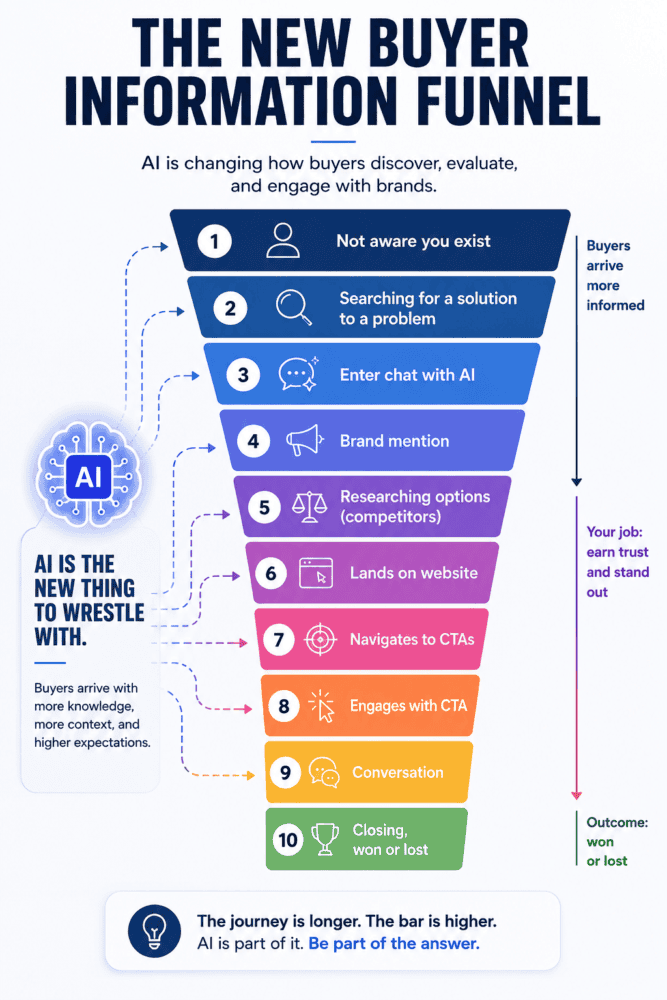
A prospect lands on your homepage. They’ve already spent 20 minutes with Claude comparing you to three competitors. They’ve read summaries of your case studies, which they never actually visited. They know your pricing range, roughly. They know your founder’s name. They’re 70% of the way to a decision.
Your homepage is still trying to sell them on what a CMS is.
This is the gap nobody warned marketing and digital leaders about. The “AI readiness” conversation got stuck on content production and search visibility – important, but downstream. The real shift is that buyers are arriving at your site with context you didn’t give them, in a buying stage your site wasn’t designed for, asking questions your CTAs don’t answer.
And it’s not a problem you fix once.
Most organizations treat AI readiness like a Y2K project. Lock it down, ship it, move on. Wrong frame. It’s closer to security or accessibility – an operating posture, not a deliverable.
Here’s why the one-and-done approach quietly breaks down:
The pattern across all three: things keep moving. A one-time fix assumes a static target. The target hasn’t been static for two years.
If AI readiness is a posture, it stands on two legs.
Governance is the human and process layer: who owns what, what’s allowed, how decisions get made, and how you measure whether any of this is working. Without it, your tools are a fast car with no driver.
Tooling is the technical layer: the stack that keeps your content structured, your brand visible to AI engines, your conversion paths aligned to AI-influenced visitors, and your team equipped to ship without breaking the system. Without it, your governance is a PDF nobody reads.
You need both. And both have to evolve.
Most “AI governance” documents I see are 40-page PDFs written by legal, approved by leadership, and ignored by everyone actually doing the work. That’s not governance – that’s compliance theater.
Real governance for marketing and digital teams looks like this:
Someone owns the prompt libraries. Someone owns the approved tools list. Someone owns the brand voice as it gets translated into AI-generated assets. Someone owns the question: “What does ChatGPT say about us, and is it accurate?” If you can’t name the human for each of those, you don’t have governance yet.
Bans push activity underground. Sanctioned tools, along with documented use cases, keep things visible. The goal isn’t to control every AI interaction your team has – it’s to make sure the high-leverage ones (anything customer-facing, anything in proposals, anything published) flow through a path you can see.
Not a static PDF. A working document – ideally structured in a way that both human writers and AI tools can pull from. What can you say about your capabilities? What’s off-limits? What’s the brand voice in three bullets, not three pages? The teams doing this well treat it like a living product, not a policy artifact.
What does “AI-ready” actually mean in your numbers? Some options worth picking from:
Pick two or three. Watch them. Adjust. You can’t govern what you don’t measure.
The tooling side isn’t about buying the trendy stack. It’s about whether your infrastructure can keep up with how fast the surrounding landscape is moving.
A few things the stack actually needs to do:
Headless and structured CMS platforms – Xperience by Kentico, Kontent.ai, Storyblok, Payload – make content machine-readable, modular, and reusable. Flat, WYSIWYG-embedded content trapped inside legacy CMS layouts is harder for AI engines to parse and harder for your team to repurpose across surfaces. If your content is stuck in one shape on one page, it’s working against you.
You can’t fix what you can’t see. Tools like OtterlyAI, which BizStream uses and partners with, track how AI engines actually describe your brand, what sources they cite, and where you’re showing up versus where competitors are. Whatever tool you pick, the principle is the same: stop guessing about your AI visibility and start measuring it.
This is the one most teams haven’t touched yet – and the one with the biggest near-term upside. More on this in the next section.
The data from AI visibility tools, your CRM, and your analytics should be talking to each other. What questions are AI engines surfacing about you? What’s converting from AI-influenced traffic? What’s not? If the answer is “we’d have to pull three reports and a spreadsheet,” you don’t have a loop – you have isolated data points.
Here’s where governance and tooling stop being abstract and start being a conversion problem. Because the buyer in our opening scene – the one who showed up 70% of the way to a decision – needs a website that meets them where they are. Most don’t.
Buyers arriving via AI assistants have already had the explainer conversation. ChatGPT told them what a headless CMS is. Perplexity gave them the pros and cons of three vendors. Your homepage hero shouldn’t be the explainer, too.
Move “what is X” content deeper into the site. Lead with positioning, proof, and decisions. The above-the-fold real estate should answer: Who do you serve? What changes when they hire you? Where do they go next? – not What is this category of thing?
The mid-decision visitor doesn’t scroll your full page. They skim, scan for proof, and either book a call or bounce. That means:
“Learn more” is the wrong ask for someone who’s already learned more than you assumed.
Better:
Pricing transparency, even directional, converts AI-influenced buyers faster. They’ve been told to look for it. Hiding it sends them back to the model to ask “what does this actually cost?” – and the model will make up an answer.
The persona docs from 2022 assumed top-of-funnel discovery. The 2026 version of that same buyer arrives mid-funnel, with a shortlist, and a Claude tab open in the next window. They’ve already disqualified two of your competitors before you knew they existed.
Realign your messaging hierarchy accordingly: validation first, education second. Proof first, pitch second. Decision-stage CTAs first, nurture flows second.
Pumping out AI-drafted blog posts without governance erodes both brand voice and trust. Volume isn't the strategy.
AI search isn't getting less important. The orgs treating it as one-and-done will be the ones wondering why their visibility dropped by next summer.
If your CMS, analytics, and CRM don't talk to each other, AI tooling on top of it just creates more confusion. Fix the foundation first.
New buyer behavior, same persona doc, is the most common reason conversion rates drop on otherwise "improved" sites.
AI readiness lives in the seam between teams. Governance that excludes either side fails.
We’ve been living this – across our own work and our clients’.
We build on modern CMS platforms (Xperience by Kentico, Kontent.ai, Storyblok, Payload, WordPress) that give marketing teams the structured content foundation AI-influenced buying journeys actually need. We run GEO and AI visibility work for clients who want to know – not guess – how they’re showing up in ChatGPT, Perplexity, and Gemini. And we help marketing and digital leaders move from one-off AI experiments to durable systems: the governance, the tooling, the conversion paths, the measurement layer.
We use AI daily inside our own operations, so when we talk about what works and what doesn’t, it’s not from a deck. It’s from the daily work.
No problem. We’ll walk through where your AI readiness actually stands today – governance, tooling, conversion paths, the whole picture – and help you prioritize what to fix first.
Adoption is about using AI tools. Readiness is about whether your organization – your content, your site, your team, your governance, your measurement – is set up to benefit from AI as it continues to evolve. You can adopt without being ready. The result is usually a lot of activity with little impact.
A few signals: shorter average session times on converting visits, higher direct or “unknown source” traffic, sales reporting leads who “already knew everything,” and form fills with much more specific questions than usual. If any of those are showing up, your AI-influenced funnel is already active – the question is whether your site is built for it.
It depends on org size, but the pattern that works: a small cross-functional group with marketing, IT, and an executive sponsor. Marketing owns the brand voice and content side. IT owns the security and tooling side. The executive sponsor unsticks decisions when the two need to align. A single owner in either silo tends to leave gaps.
Quarterly review, monthly check-ins on the metrics. The cadence is closer to security reviews than to annual strategic planning. The landscape moves too fast for an annual cycle to be the only touchpoint.
Sometimes you need new tools – usually for AI visibility monitoring and structured content if you’re on a legacy CMS. Often, though, the bigger gap is connecting what you already have. Most teams have more data and capability than they’re using. The fix is integration and governance before it’s procurement.

Stay up to date on what BizStream is doing and keep in the loop on the latest in marketing & technology.