Agentic AI Is Reshaping Marketing: What We Shared at Tech Week Grand Rapids 2026

BizStream hosted a packed Tech Week Grand Rapids session on how agentic AI is reshaping marketing. Here are some of the takeaways.

On September 15, a standing-room-only crowd of over 100 marketers, business leaders, and technologists filled Secchia Piazza at Grand Rapids Community College (GRCC) for our Tech Week Grand Rapids session, How Agentic AI Is Shaping the Future of Marketing. Thanks to our sponsor, GRCC, for the space and the refreshments, and to everyone who spent an afternoon thinking through where this is all going with us.

Summary

AI is no longer just a tool marketers reach for, it’s changing how the work gets done and even who the content is written for. Our session walked through what that shift looks like today, where we think it’s heading, and what it means for marketers.

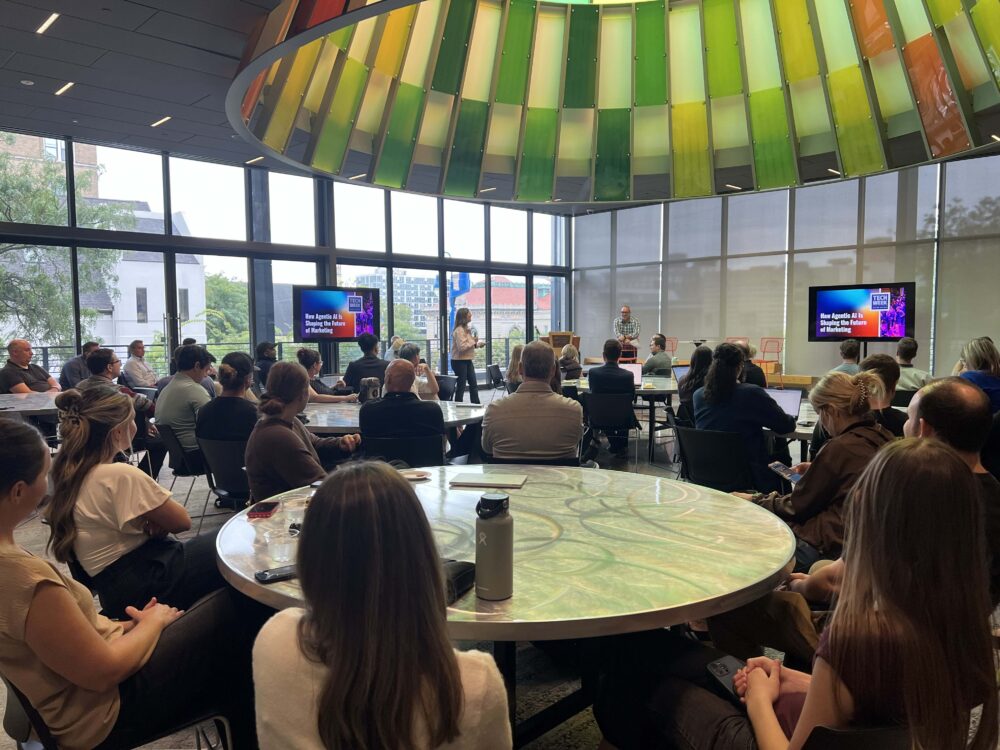
A full audience at BizStream's agentic AI marketing session during Tech Week Grand Rapids, held under the glass SkyCone at GRCC's Secchia Piazza.
Dr. Kristi Haik, Dean of STEM at Grand Rapids Community College, welcomes the room and shares more about GRCC's AI programs. GRCC hosted our session and generously donated the space and refreshments.

What we heard from attendees afterward kept coming back to two ideas: designing websites that AI agents can read, and shifting toward marketers owning the strategy while AI owns the execution.

Here are the takeaways that resonated most:

  • You’re marketing to machines now, not just people. AI agents read your content alongside human visitors, so they’ve become an audience of their own, which is the shift behind business-to-agent, or B2A, marketing.
  • AI is moving into every part of the MarTech stack. That includes the CMS and DXP, where across WordPress, Storyblok, Kontent.ai, and Kentico, agents are starting to read, update, and optimize content directly, turning the platform into an active collaborator.
  • The next step is orchestrated agentic loops. We think marketers will direct teams of AI agents that handle the execution while they own the strategy and the outcomes.
  • Human judgment stays essential. The advice from the room was to automate the repetitive, testable work and keep high-risk, hard-to-reverse decisions with people.
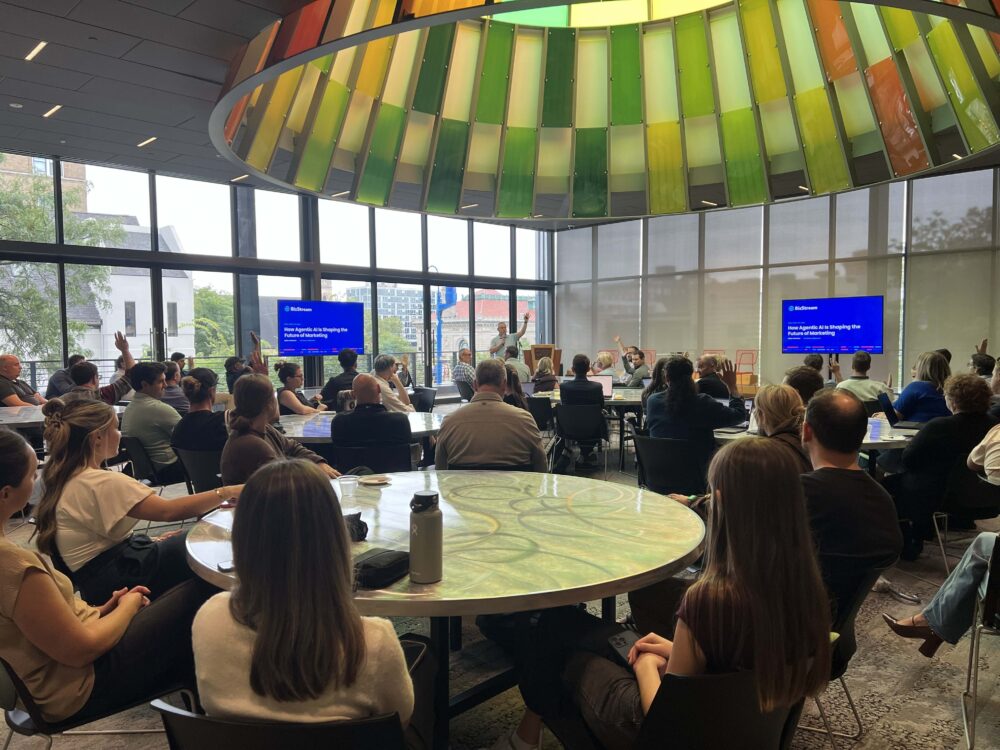
Brian McKeiver presents to a full, engaged audience with several hands raised during BizStream's agentic AI session at Tech Week Grand Rapids, beneath the colorful glass SkyCone at GRCC's Secchia Piazza.
Brian McKeiver, BizStream co-owner and solutions architect, kicks off the session on how AI is reshaping marketing.

Marketing Now Has Two Audiences

Brian McKeiver, our co-owner and solutions architect, opened by naming the shift underneath everything else. For years we’ve marketed to people, and now we’re also marketing to machines. AI agents increasingly read, summarize, and act on web content, which means how you structure that content matters as much as how it reads to a person.

That change has real implications. We now have to design for AI agents as a distinct audience, a move the industry increasingly calls business-to-agent, or B2A, marketing, alongside the people we’ve always designed for. Drawing on research from Forrester and others in the CMS space, Brian walked through what it means to serve an audience that wants logic, structure, and accuracy instead of story and emotion.

Brian’s bigger point was that serving these agents well takes more than content. It takes context, integrity, data, and governance, all working together to keep your answers accurate. When an agent surfaces something outdated or wrong from your site, that becomes your problem to own.

A lot of this comes back to a term you’re hearing more often: generative engine optimization, or GEO, the work of structuring and writing your content so AI tools can find it, understand it, and cite your brand when someone asks a question, much like SEO shaped content for search engines. It’s one of a handful of related AI-search practices, and getting found in AI search is quickly becoming its own priority alongside traditional SEO.

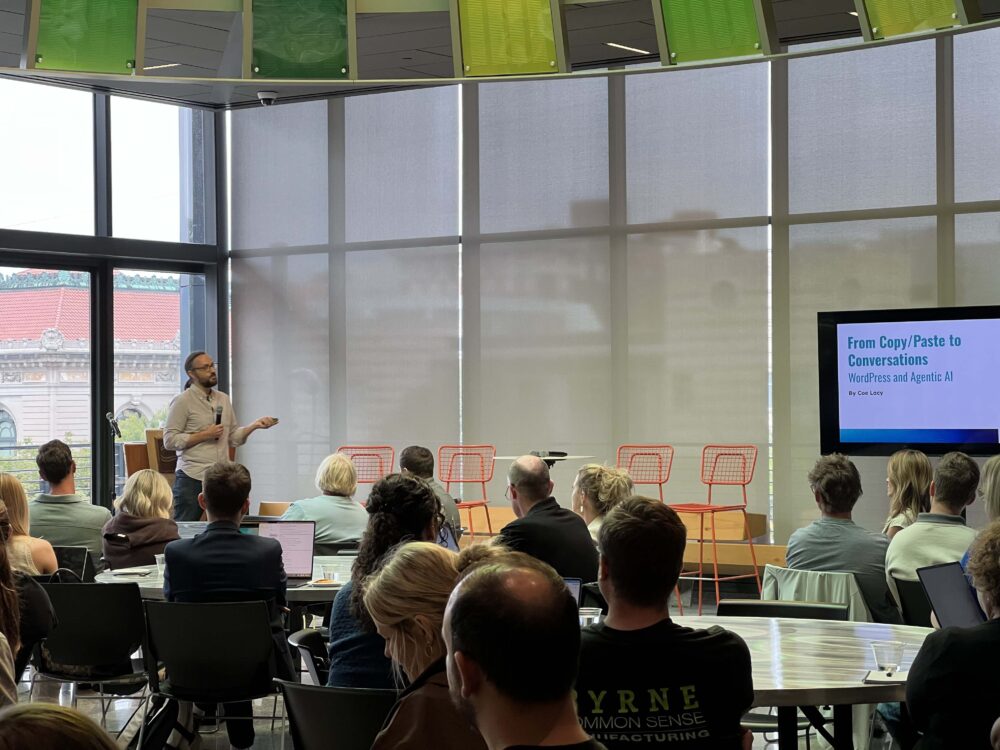
Coe Lacy speaks to a seated audience next to a slide reading "From Copy/Paste to Conversations: WordPress and Agentic AI" during BizStream's session at Tech Week Grand Rapids.
BizStream art director Coe Lacy walks the room through how WordPress is moving from copy and paste to conversation with agentic AI. His segment kicked off the CMS demos, which also covered Storyblok, Kontent.ai, and Kentico.

What This Looks Like Inside the CMS Today

The middle of the session got practical, with quick demos across the platforms we build on.

Coe Lacy, our art director, showed how WordPress, which runs roughly 43% of the web, is moving from copy and paste to conversation. With the new Abilities API and MCP connectors, an agent can read and update a site directly. For example, instead of hand-building thirty location pages one at a time, you hand an agent a spreadsheet and it builds and publishes them for you.

WordPress is becoming a place not just where you work, but something you work with.

Drew Veach, our CMS and AI strategy lead, walked through Storyblok, a headless CMS built to create content once and publish it anywhere. He demoed FlowMotion, an automation layer that takes a single blog post and drafts a LinkedIn post from it, with a human approval step before anything goes live, so the team gets more output without losing the human in the loop.

Brian closed the demos with Kontent.ai and Kentico. He showed an agent finding every mention of a term across a site and updating them in bulk, then another running live SEO and GEO analysis on a page from inside the CMS. The through-line across all four platforms was the same: the CMS is quietly becoming an active collaborator, not just a place to store pages.

Ā 

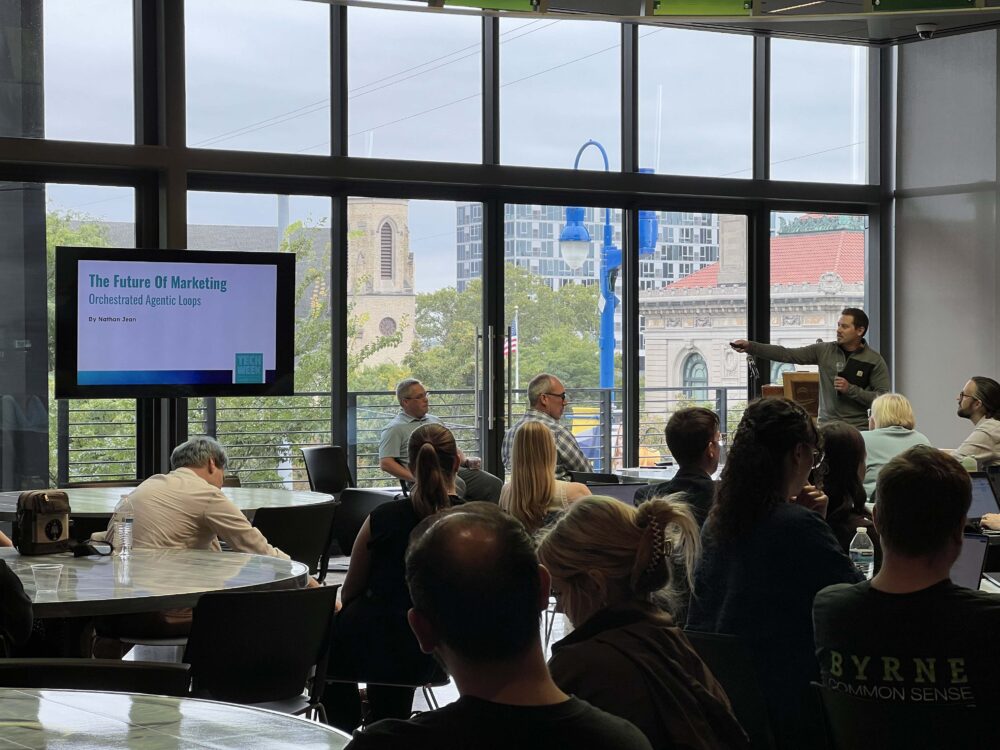
Nate Jean gestures toward the audience beside a slide reading "The Future Of Marketing: Orchestrated Agentic Loops" during BizStream's session at Tech Week Grand Rapids.
BizStream AI strategist Nate Jean closes the session with our take on where marketing is heading, from orchestrated agentic loops to marketers directing teams of AI agents.

Where We See This Heading: Orchestrated Agentic Loops

Nate Jean, our AI strategist, closed the session with our view of where marketing AI goes over the next few years, and it was the part of the afternoon people kept bringing up.

We think the next shift is toward what we call orchestrated agentic loops, where marketers stop handling the execution themselves and start directing teams of AI agents that carry it out. To make that idea concrete, Nate built a prototype of an agentic marketing operating system called Loop. In it, a marketer named Amber owns the strategy and the outcomes and steers those agent teams. She says she needs a landing page, an email sequence, and a four-week social calendar in fourteen days, and an orchestrator agent puts the ops, content, design, media, and CMS agents to work, checking back in only when it needs her judgment.

The piece that drew the most interest was the panel agent, which spins up a set of AI personas built from real buyer behavior and pressure-tests a campaign before launch, surfacing exactly where a real visitor would get stuck. Our belief is that marketers are not replaced in this world, they are supercharged, running more campaigns with more optimization than a team could manage by hand. Loop is a prototype we built to show where we think the tools are going, not something you can buy today.

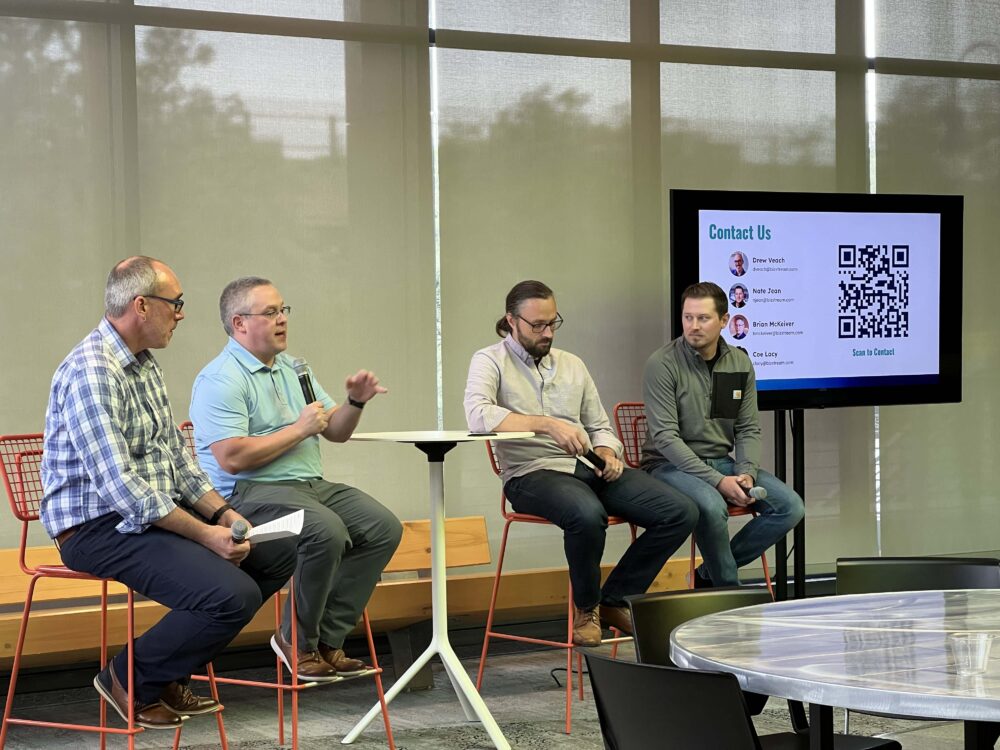
Four BizStream panelists seated on stools take audience questions beside a "Contact Us" slide, with one speaking into a microphone, during the Q&A at Tech Week Grand Rapids.
The session closed with a panel and Q&A featuring the full BizStream team, Drew Veach, Brian McKeiver, Coe Lacy, and Nate Jean, fielding questions from the room on putting agentic AI to work.

Questions From the Room

We ended the event with some Q&A. Here are a few of the takeaways:

Where to start: pick one AI tool you like, explain your work and your problems to it, and let it quiz you on what you know and what you don’t. Begin with the repetitive, testable work, and keep the high-risk, hard-to-reverse tasks like payment processing or HR decisions in human hands.

On judgment: every answer an agent gives still carries your name, so a person has to be the final check on quality and accuracy, and that human judgment is the real advantage. As Brian put it in his own recap of the day, “start small, find the repetitive work, and figure out where agents can make your team more effective.”

Start small, find the repetitive work, and figure out where agents can make your team more effective.

On runaway agents: most of the alarming stories come from consumer-grade experiments with no guardrails. In an enterprise setting, with the controls the major platforms now provide, that risk drops sharply.

What It Means for Marketers

The technology is moving fast, but the takeaway is steady. AI is changing how the work gets done, and the marketers who benefit most are the ones who bring the strategy and judgment the machines still cannot. That is the shift we’re helping clients work through, from getting a site ready for AI search to figuring out where agents actually fit.

If you’re thinking through what agentic AI means for your marketing, we’d love to talk. And if you want a practical place to start on getting found in AI search, our Introduction to GEO guide is a good first step.

Frequently Asked Questions About Agentic Marketing

Agentic marketing is the use of AI agents that don’t just answer questions but take action, like drafting content, updating pages, or running parts of a campaign, while a person directs the strategy and reviews the output.

AI agents need more than polished copy. They need information that’s structured, accurate, and easy to parse, backed by the right context, integrity, data, and governance so the answers they surface stay correct.

B2A marketing treats AI agents as a distinct audience. Because agents increasingly read and act on web content for people, marketing to them calls for logic, structure, and accuracy rather than story and emotion.

Generative engine optimization, or GEO, is the practice of structuring and writing your content so generative AI tools like ChatGPT, Claude, Gemini, and Perplexity understand it and cite your brand in their answers. It’s the AI-search counterpart to traditional SEO, and one of several related practices for staying visible as AI reshapes search.

They’re related but not the same. SEO optimizes content to rank in traditional search results. AEO, answer engine optimization, targets direct answers in features like snippets and voice search. GEO, generative engine optimization, aims to be understood and cited by generative AI tools. AIO, AI optimization, is the broad umbrella across all of these. LLMO, large language model optimization, focuses on structuring data so large language models interpret and reference your brand correctly.


Start by picking one AI tool, explaining your work and goals to it, and automating the repetitive, testable tasks first, while keeping high-risk or hard-to-reverse decisions in human hands.

About the Author

Michelle Lentz

Michelle has an eye for design and aesthetics and enjoys applying these principles to business. Merging her love of all things artisan with her business experience, Michelle joined BizStream in 2013 to take on our marketing efforts. Michelle is skilled in web admin, digital marketing, design, content creation, event planning, driving our unique BizStream culture, and more. In her free time, you’ll find her gardening, doing houseplant chores, or exploring nature with her husband and two daughters.

Subscribe to Our Blog

Stay up to date on what BizStream is doing and keep in the loop on the latest in marketing & technology.